
Airyx OPC‑VIS‑LED‑300 Hybrid Open Path DOAS Instrument
PRECISE OPEN-PATH AND VERTICAL MAX-DOAS MEASUREMENTS FOR ADVANCED GAS AND AEROSOL MONITORING.
Description
This section provides an overview of the hybrid open‑path and MAX‑DOAS concept used by the OPC‑VIS‑LED‑300.
Hybrid DOAS concept
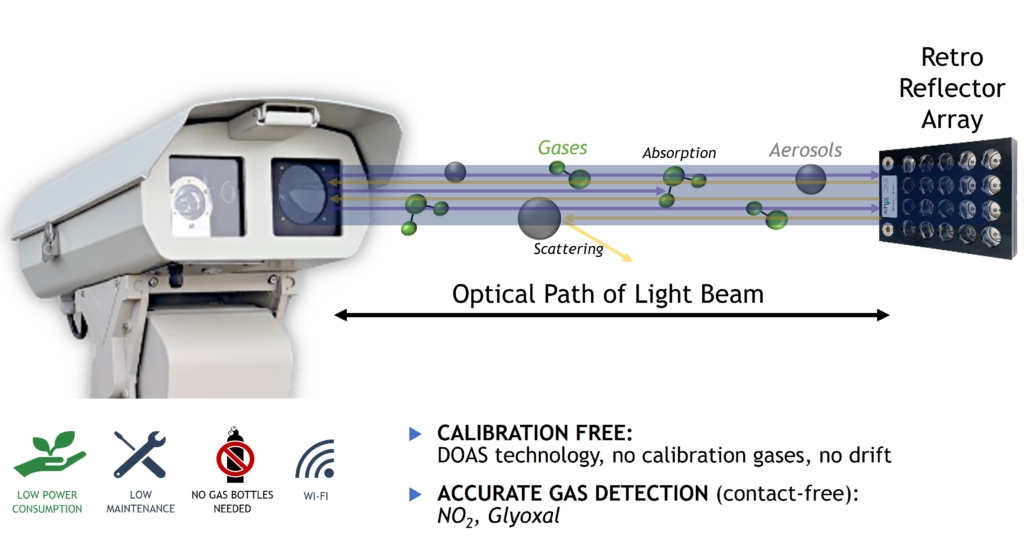
The Airyx OPC‑VIS‑LED‑300 is a hybrid open path DOAS instrument. It combines active open‑path DOAS and passive MAX‑DOAS in one compact system. As a result, it supports long‑path concentration measurements and vertical profiling in a single device.
Multi‑path open‑path mode
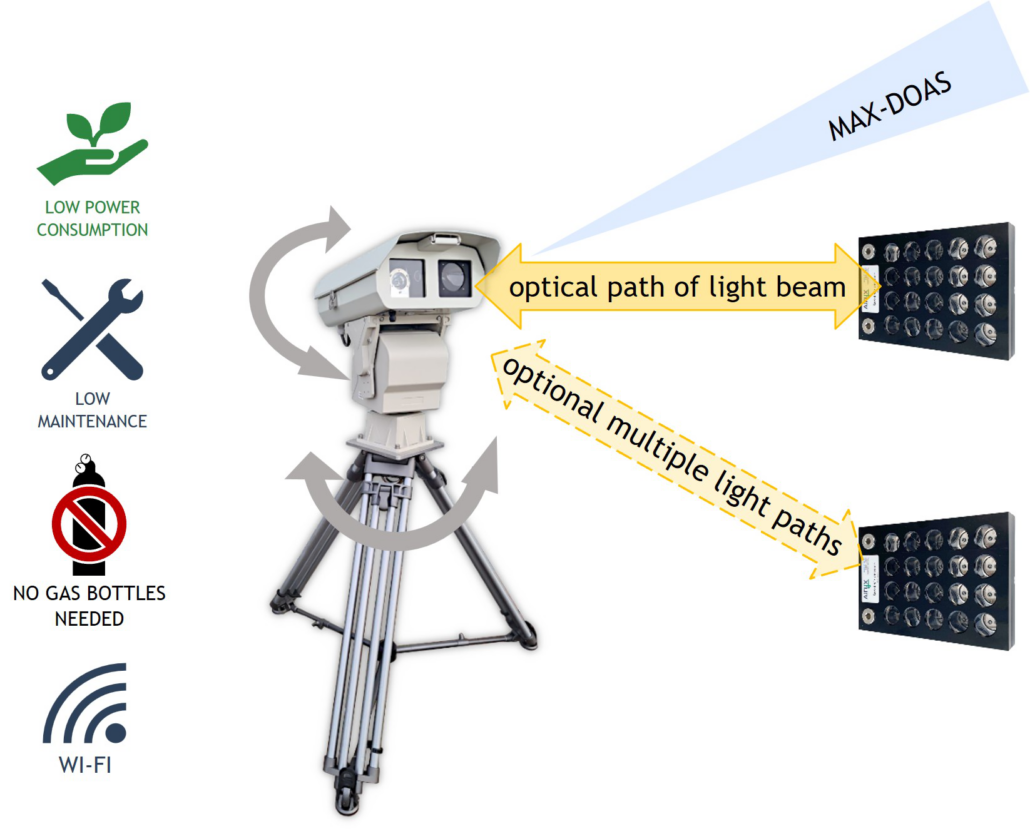
In active mode, a 450 nm LED and retroreflectors create a defined optical path for NO₂ and Glyoxal measurements. Meanwhile, the motorized UV telescope can switch between several reflectors, enabling tomography, fence‑line monitoring and spatial coverage without manual alignment.
Passive MAX‑DOAS mode
In passive mode, the instrument retrieves vertical profiles of NO₂, H₂O, Glyoxal, HCHO, HONO, O₃, O₄, SO₂, IO, BrO and OClO. Therefore, it supports a wide range of atmospheric and air‑quality applications.
A temperature‑stabilized spectrometer (300–550 nm, FWHM < 0.5 nm) ensures precise spectral data. In addition, the stable optical design supports accurate retrievals in both active and passive operation.
Thanks to its IP64 housing and internal heating, the OPC‑VIS‑LED‑300 performs reliably in demanding outdoor environments. Consequently, it is suitable for both short‑term campaigns and long‑term monitoring. Moreover, combining two measurement modes in one instrument reduces equipment complexity in the field.
System Overview
The image illustrates the main components and beam geometry of the hybrid open‑path and MAX‑DOAS setup.
Key Features
The hybrid open path DOAS design provides accurate long‑path gas measurements and multi‑species retrievals from a single compact setup.
Accurate gas detection
Active open‑path DOAS detects NO₂ and Glyoxal with proven optical stability. Long‑path remote sensing avoids losses in sampling lines and improves accuracy under varying atmospheric conditions.
Vertical profiles via MAX‑DOAS
Passive MAX‑DOAS retrievals deliver vertical profiles of NO₂, H₂O, Glyoxal, HCHO, HONO, O₃, O₄, SO₂, IO, BrO and OClO. This supports detailed boundary‑layer and atmospheric chemistry studies.
Compact and flexible hybrid design
Active and passive DOAS measurements are integrated in one compact unit. As a result, the system reduces logistical complexity during field deployments and survey campaigns.
Rugged and mobile
An IP64 housing with internal heating and dew‑point monitoring ensures stable performance in outdoor environments. Optional battery operation increases mobility for remote sites.
Plug‑and‑play setup
The motorized telescope allows automatic self‑alignment. Consequently, the instrument can be deployed quickly and used for tomography or fence‑line monitoring with minimal effort.
Calibration‑free operation
DOAS technology does not require calibration gases and shows no significant long‑term drift. Therefore, operating costs remain low even during extended measurement periods.
Applications
The OPC‑VIS‑LED‑300 hybrid analyzer supports both open‑path and vertical profiling applications. Therefore, it is suitable for a wide range of atmospheric and industrial monitoring tasks. As a result, users can answer several atmospheric questions with only one instrument.
- Air‑quality monitoring and workplace exposure analysis
- Industrial emission oversight and process control
- Satellite validation near the surface (MAX‑DOAS)
- Boundary‑layer chemistry and aerosol optical property studies
- Fence‑line monitoring at industrial or agricultural sites
- Tomographic spatial distribution analysis using multiple reflectors
In addition, the system design simplifies field handling and reduces deployment time. This makes the OPC‑VIS‑LED‑300 a flexible solution for both temporary campaigns and fixed monitoring stations.
For ammonia monitoring, see our OPC‑UV3‑DL‑301.
For greenhouse‑gas monitoring, visit the WGA020 product page.
Frequently Asked Questions
What measurement techniques does the OPC‑VIS‑LED‑300 use?
The instrument combines active open‑path DOAS using a 450 nm LED with passive MAX‑DOAS. This hybrid approach enables both long‑path concentration measurements and vertical profile retrievals.
Which gases can be detected in active open‑path mode?
In active mode, the OPC‑VIS‑LED‑300 detects NO₂ and Glyoxal along a defined optical path between the telescope and a retroreflector.
Which species are available in MAX‑DOAS mode?
Passive MAX‑DOAS retrievals provide information on NO₂, H₂O, Glyoxal, HCHO, HONO, O₃, O₄, SO₂, IO, BrO and OClO, as well as aerosol optical properties. Therefore, the system supports a broad range of atmospheric studies.
What typical path lengths are possible?
Open‑path measurements can be performed over distances of up to 1000 m. The achievable range depends on visibility, reflector configuration and integration time.
Does the instrument require calibration gases?
No. DOAS measurements are inherently calibration‑free and do not require calibration gas cylinders. This significantly simplifies operation and reduces long‑term costs.
Measurement Setup Illustration
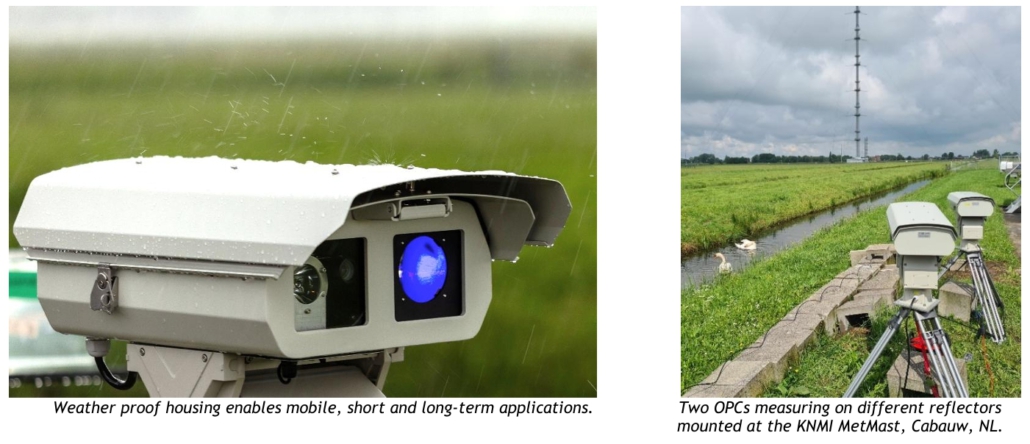
This diagram shows typical instrument placements and viewing geometries used in field deployments.
Optical and Measurement Specifications
The following parameters describe the optical configuration, spectrometer characteristics and detectable gases of the OPC‑VIS‑LED‑300.
| Parameter | Specification |
|---|---|
| Optics | UV lens telescope, 300 mm focal length |
| Light Source | LED 450 nm (*) |
| Detectable Gases (Open‑Path) | NO₂, Glyoxal |
| Limit of Detection (500 m, 1 min) |
NO₂: 2.2 ppb Glyoxal: 2.2 ppb Values depend on visibility and path length |
| Detectable Gases (MAX‑DOAS Passive Mode) | NO₂, H₂O, Glyoxal, HCHO, HONO, O₃, O₄, SO₂, IO, BrO, OClO |
| Time Resolution | Up to 5 s per light path |
| Path Length to Reflector | Up to 1000 m (**) |
| Compact Spectrometer | 300–550 nm, FWHM < 0.5 nm, temperature stabilized |
Mechanical and System Specifications
This section summarizes mechanical design, housing protection, electronics and power consumption based on the system datasheet.
| Parameter | Specification |
|---|---|
| Motorization | Azimuth 0°–360°, Elevation −40° to 75° |
| Housing | IP64, internal heating, dew‑point monitoring |
| Control Unit | Integrated embedded PC, Windows 10 IoT |
| Temperature Control | Heating (cooling on request) |
| Additional Sensors | Elevation, ambient temperature, pressure, internal dew point |
| Data Interfaces | Internal data storage, LAN, WiFi, machine‑to‑machine |
| Power Supply / Consumption | 24 V, 50 W max. (12 V version & battery operation available) |
Overall, the OPC‑VIS‑LED‑300 hybrid open path DOAS instrument combines optical performance and robust system design for demanding field deployments.
Interested in hybrid open‑path and MAX‑DOAS monitoring?
Contact our team for technical details, pricing or application support.
Get in Touch with Airyx
Find your local Airyx distributor or contact our Heidelberg team directly. Moreover, we support you with product questions, technical assistance and partnership inquiries.
Contact Airyx Headquarters
Airyx GmbH is based in Heidelberg, Germany. In addition, our team supports customers worldwide in environmental monitoring, wastewater emissions and air‑quality research.
Furthermore, we provide fast technical assistance and reliable guidance for instrument selection.
How to Reach Our Team
Email: info@airyx.de
Phone: +49 6221 9068977
Address:
Airyx GmbH
Hans‑Bunte‑Str. 4
69123 Heidelberg, Germany
If you need product information, quotations or technical assistance, please get in touch. As a result, you can rely on quick feedback when requesting quotations, technical details or product recommendations.
Send Us a Message
Find Your Local Distributor
Regional Expertise for DOAS and Gas‑Analysis Systems
Select your region below to find the appropriate Airyx distributor. As a result, you benefit from local expertise and shorter response times.
Europe
Europe
France

MEGATEC SAS
Saint-Aubin, France
Website: https://www.megatec.fr/
Contact: https://www.megatec.fr/contact
Contact person: Fabrice Losbar
Czech Republic, Slovakia & Lithuania

ENVItech Bohemia s.r.o.
Prague, Czech Republic
Website: https://www.envitech-bohemia.cz/
Contact: https://www.envitech-bohemia.cz/en/kontakt
Spain & Portugal

Green Light Research SLU
Madrid, Spain
Website: https://www.greenlightresearch.net/
Contact: https://www.greenlightresearch.net/contacto/
Italy

Luchsinger SRL
Curno, Italy
Website: https://www.luchsinger.it/
Contact: https://www.luchsinger.it/it/contatti/
Netherlands, Belgium, Luxembourg, Nordics

The Dutch Scientist
's‑Hertogenbosch, NL
Website: https://www.thedutchscientist.com/
Contact: https://www.thedutchscientist.com/CONTACT/
Finland

HNU Nordion
Helsinki, Finland
Website: https://hnunordion.fi/
Contact: https://hnunordion.fi/yhteystiedot/
Greece

Polaris Environment Ltd
Athens, Greece
Website: http://www.polaris-environment.gr/
Romania (ICAD only)

APEL LASER
Mogosoaia, Romania
Website: https://www.apellaser.ro/
Romania (Open Path, SkySpec, WGA)

PHANOS
Bucharest, Romania
Website: https://phanossci.com/
Bulgaria & Western Balkans

STABO‑Tech Ltd.
Stara Zagora, Bulgaria
Website: http://stabo-tech.eu/
Asia
Asia
India

M&G Analyzer Systems
Pune, India
Website: https://www.mganalyser.com/
Vietnam

Reeco Science & Technology Co.
Ho Chi Minh City, Vietnam
Website: https://reecotech.com.vn/
Indonesia

PT JJExotranoz Inter Vania
Cibubur, Indonesia
Contact: Jefry KP
China

Li‑Ca Scientific
Website: http://en.li-ca.com/
Additional Regional Availability
We also provide local support in Hong Kong, Macau and Taiwan through additional regional partners.
Global Distributor Network
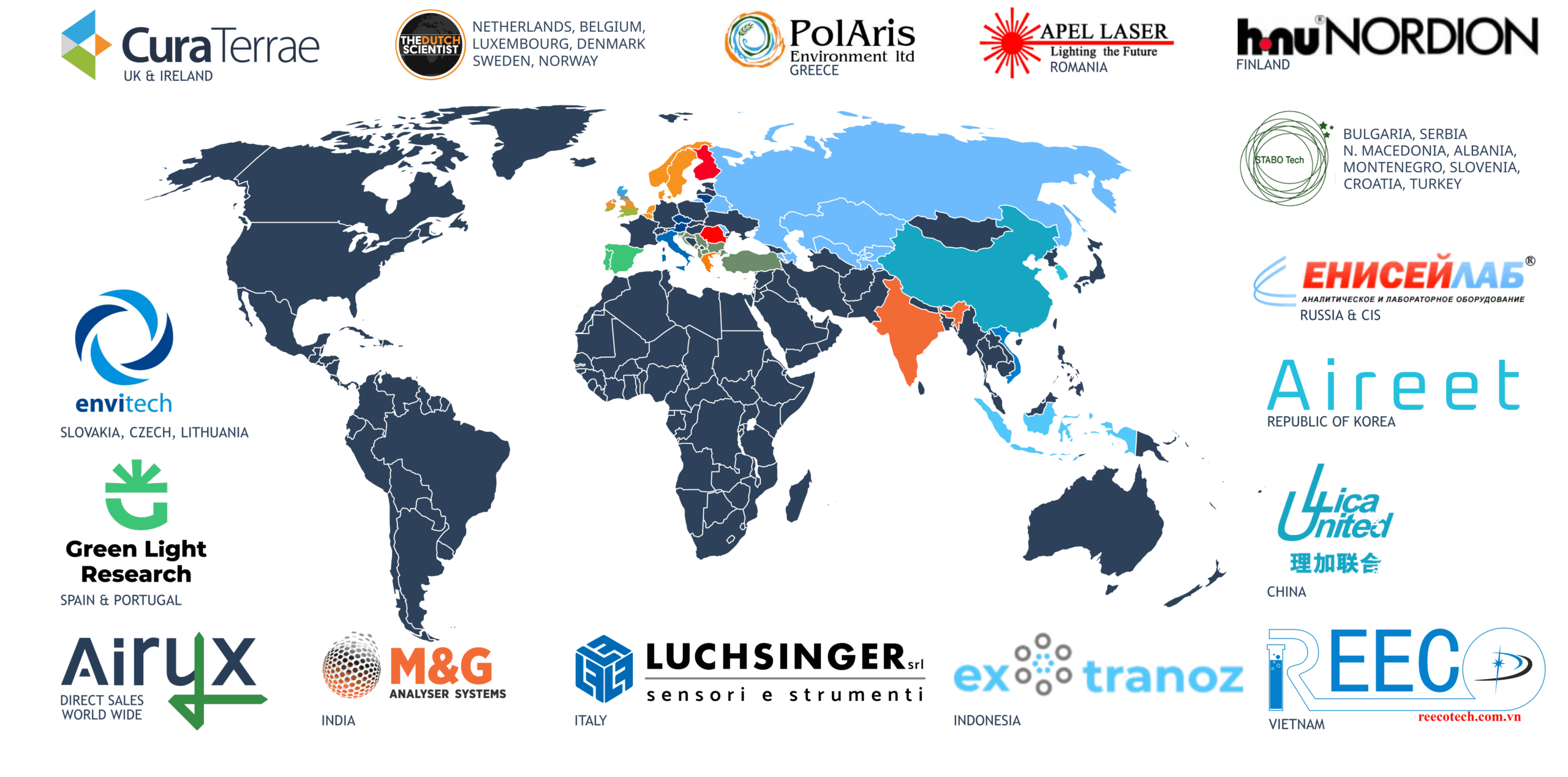
Airyx works with a selected network of regional distributors who provide local expertise in air‑quality monitoring, DOAS‑based systems, wastewater gas analysis and real‑world emissions measurement.
Worldwide Coverage at a Glance
Your Nearest Airyx Partner
Need Technical Support?
Get Fast Assistance from Our Technical Specialists
If you need troubleshooting, data interpretation or guidance for your emissions‑monitoring setup, our technical team is ready to assist you.