
Airyx Enables High‑Resolution Real‑World Emission Measurements in New Plume‑Chasing Study
A new peer‑reviewed study published in Science of the Total Environment (2026) demonstrates the power of high‑resolution Plume Chasing for determining real‑world vehicle emissions. Airyx contributed key measurement data, enabling large‑scale screening of cars, buses and trucks under real driving conditions in Czechia.
The study analysed emissions from more than 1,400 vehicles, including light‑duty cars, urban buses and heavy‑duty trucks. Real‑world emissions of nitrogen oxides (NOx), particle number (PN) and black carbon (BC) were quantified directly on the road, providing insights into fleet behaviour beyond controlled laboratory testing.
Identifying high‑emitting vehicles in the real world
A central finding of the study is the disproportionate impact of a small number of vehicles on total emissions. Depending on pollutant and vehicle category, only a few percent of the fleet accounted for around half of overall emissions. This clearly underlines the value of real‑world screening methods for rapidly identifying high emitters.
Comparison of remote sensing and Plume Chasing
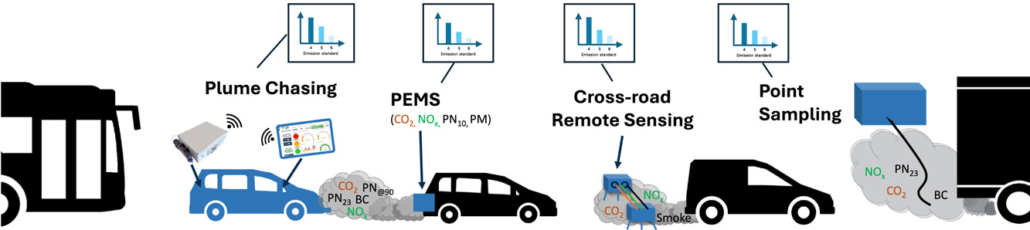
For the first time, multiple remote emission sensing techniques were directly compared with high‑resolution Plume Chasing in urban traffic. Measurements were performed at co‑located sites using different remote‑sensing setups, complemented by Portable Emission Measurement Systems (PEMS) on selected vehicles.
While average emission factors across the remote‑sensing methods were broadly comparable, individual vehicle results showed substantial variability depending on technique and measurement interval. Plume Chasing exhibited the smallest deviation from PEMS, likely due to longer observation times and coverage of varying engine loads, capturing real driving behaviour more accurately.
Why high‑precision Plume Chasing matters
The results highlight the importance of high‑resolution and high‑precision measurements for realistic emission assessment. Short sampling intervals and unstable plume capture can lead to large uncertainties for individual vehicles. By dynamically tracking exhaust plumes over extended periods, Plume Chasing reduces these uncertainties and delivers emission factors that better reflect true on‑road performance.
These findings underline the value of Airyx mobile emission measurement technology for urban environments. Continuous plume capture supports fleet screening, regulatory monitoring and research applications where robustness and real‑world representativeness are critical.
About the study
The study was conducted by an international consortium of universities and research organisations across Europe. It represents one of the most comprehensive evaluations of Plume Chasing and remote emission sensing to date and demonstrates the potential of high‑resolution mobile measurements to identify emission hotspots, support enforcement and improve understanding of fleet‑level emissions.
Further peer‑reviewed studies and technical publications involving Airyx measurement technology can be found on our Research & Publications page.
Reference:
Schmidt, C., Pöhler, D., Knoll, M., Vojtíšek, M., Pechout, M., Frateur, T., Lollinga, J.P., Ligterink, N.E., Platt, U. (2026). Real driving emissions of cars, buses and trucks determined by Plume Chasing in Czechia: Fleet screening and intercomparison with other methods. Science of the Total Environment, 1015, 181391.
https://doi.org/10.1016/j.scitotenv.2026.181391