
We’re excited to highlight a new publication from the SAPHIR-CHANEL campaign, where our ICAD HONO instrument supported advanced chamber studies of urban VOC oxidation. The study provides new insights into how organic nitrates form and partition under realistic daytime and nighttime conditions, improving our understanding of secondary organic aerosol (SOA) formation. These findings contribute to more accurate air quality modeling and a better assessment of nitrogen deposition in complex urban environments.
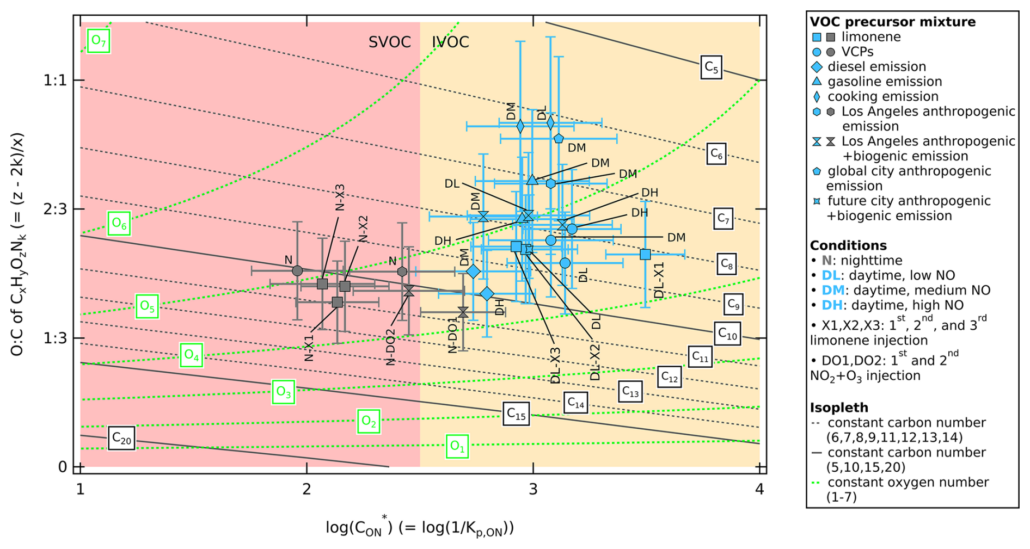
Two-dimensional volatility basis set mapping expressed as logarithm of effective saturation concentration of organic nitrate (log(C∗ ON) = log(1/Kp,ON)) in a 2D space with log(C∗ ON) on the x axis and O : C ratio of CxHyOzNk (= (z−2k)/x) on the y axis. The val ues of log(C∗ ON) during SAPHIR-CHANEL campaigns for various urban VOC-NOx mixture experiments are shown color-coded by daytime (light blue) and nighttime (dark grey) conditions. The horizontal whiskers represent the uncertainty of log(C∗ ON) (see Sect. S3.3 for uncer tainty propagation). The vertical whiskers represent the uncertainty from using WALL-E signal as an indication of concentration (estimated to be 50%). Organic composition from the group contribution method based on the carbon number (ni C) and oxygen number (ni O) are shown to describe organic aerosol volatility as isopleths at 300 K following Donahue et al. (2011), with parameterizations following Stolzenburg et al. (2018) as described in Sect. 2.5.1. The dark grey lines represent carbon number isopleths and the light green curves represent oxygen number isopleths. The volatility range of semi-volatile organic compounds (SVOC) and intermediate-volatility organic compounds (IVOC) are highlighted red and yellow, respectively.
Gas-particle partitioning, molecular weight, and yield of organic nitrate under different urban VOC, NOx, and oxidation conditions during SAPHIR-CHANEL campaign
Nursanto, F. R., He, Q., van de Wouw, S., Zanders, A., Hohaus, T., Kroese, W. S. J., Wegener, R., Adam, M. G., Winter, B., Dubus, R., Kesper, L., Rohrer, F., Wang, Y., Matthews, E., Voliotis, A., Bannan, T. J., McFiggans, G., Coe, H., Wu, Y., Roska, M., Canagaratna, M., Alton, M., Coggon, M. M., Stockwell, C. E., Bates, K. H., Pfannerstill, E. Y., Zorn, S. R., Wang, H., Riva, M., Perrier, S., Yang, B., Liu, L., Novelli, A., Färber, M., Fuchs, H., Marcillo Lara, A. C., Grasse, A., Wesolek, C., Tillmann, R., Holzinger, R., Krol, M. C., Gkatzelis, G. I., and Fry, J. L.: Gas-particle partitioning, molecular weight, and yield of organic nitrate under different urban VOC, NOx, and oxidation conditions during SAPHIR-CHANEL campaign, Atmos. Chem. Phys., 26, 8425–8453, https://doi.org/10.5194/acp-26-8425-2026, 2026.
Oxidation of volatile organic compounds (VOCs) involving hydroxyl radicals (OH•) and nitrogen oxides (NOx), or nitrate radicals (NO3•) forms organic nitrates that undergo gas-particle partitioning, changing the lifetime of nitrogen and their deposition on ecosystems. In urban areas, VOC composition is complex, with contributions from traffic, cooking, volatile chemical products (VCPs), and biogenic emissions. Secondary organic aerosol (SOA) formation from urban VOC mixtures was investigated using chamber experiments during the SAPHIR-CHANEL campaign under realistic VOC-NOx and oxidation conditions. The yield of total organic nitrates is higher for precursor mixtures with a higher percentage of unsaturated VOCs, such as those from traffic and cooking sources (11 %–21 %), compared to VCPs and complex urban emission replicas (2 %–7 %). Enhanced particle-phase partitioning is observed under nighttime oxidation (by NO3•) versus daytime oxidation (by OH•). Particulate organic nitrates have a higher average molecular weight under nighttime conditions (330 ± 80 g mol−1) than under daytime conditions (250 ± 30 g mol−1) mainly due to a higher dimer fraction. Similarly, the mass fraction of the total organic aerosol that is organic nitrate is 2.6–4.5 times higher under nighttime than daytime conditions, likely due to higher molecular weight and lower temperatures. Although gas-phase organic nitrate composition varies substantially between precursor mixtures, bulk organic nitrate partitioning is generally similar to that of modeled oxidized monoterpene nitrates (10−4–10−2 m3 µg−1 at 18–40 °C). These findings improve understanding of bulk organic nitrate sources and properties in complex urban environments, allowing better simulations of air quality and nitrate deposition.