SkySpec Marine Aerosol Monitoring
New Publication Demonstrates the Power of MAX-DOAS for Marine Aerosol Monitoring
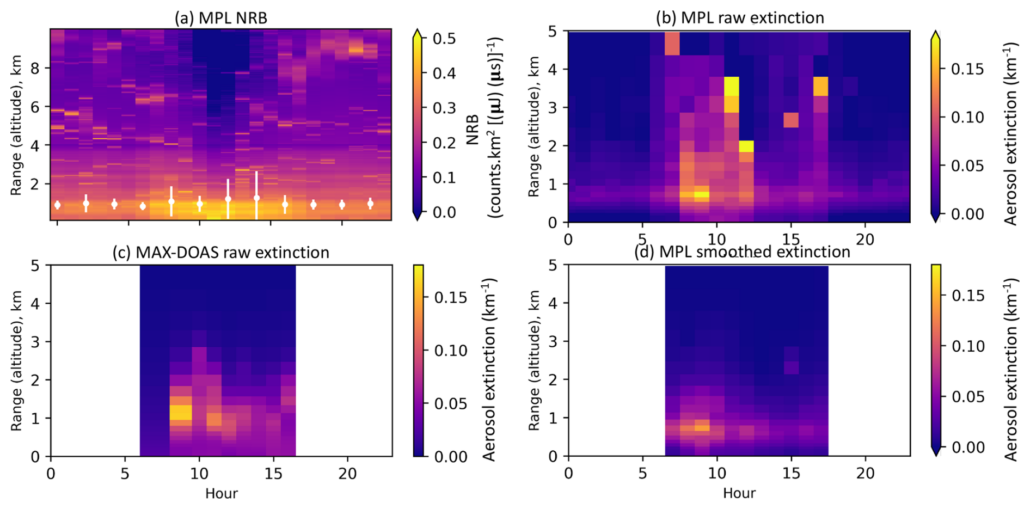
Diurnal and vertical profile results at OTI. (a) NRB from the MPL (0–10 km altitude), with white dots indicating the mean diurnal variation of the boundary layer height; (b) raw, cloud-filtered aerosol extinction from the MPL (0–5 km altitude); (c) raw, cloud-filtered aerosol extinction from the MAX-DOAS (0–5 km altitude); and (d) aerosol extinction from the MPL, at the MAX-DOAS vertical resolution and smoothed using MAX-DOAS averaging kernels (0–5 km altitude).
We are excited to announce a new scientific publication showcasing the performance of MAX-DOAS technology for aerosol measurements in one of the world’s most unique marine environments: the Southern Great Barrier Reef, Australia.
The study combines MAX-DOAS and lidar observations to investigate the vertical distribution of atmospheric aerosols above One Tree Island. The results demonstrate excellent agreement between both measurement techniques and confirm that dual-wavelength MAX-DOAS retrievals provide highly reliable aerosol extinction profiles and aerosol optical depth measurements, even under challenging conditions characterised by high humidity, frequent low clouds and clean marine air masses.
As interest grows in understanding aerosol-cloud interactions and evaluating climate intervention concepts such as marine cloud brightening, accurate observations of aerosol properties become increasingly important. The presented measurements provide valuable reference data for atmospheric research, model validation and future climate studies in the Great Barrier Reef region.
This work further highlights the capability of MAX-DOAS as a robust, field-proven remote sensing technology for aerosol characterization and atmospheric monitoring across a wide range of environments.
Publication:
Ryan, R. G., Toms-Hardman, L., Smirnov, A., Harrison, D. P., and Schofield, R. (2025). Measurement report: Aerosol vertical profiling over the Southern Great Barrier Reef using lidar and MAX-DOAS measurements.